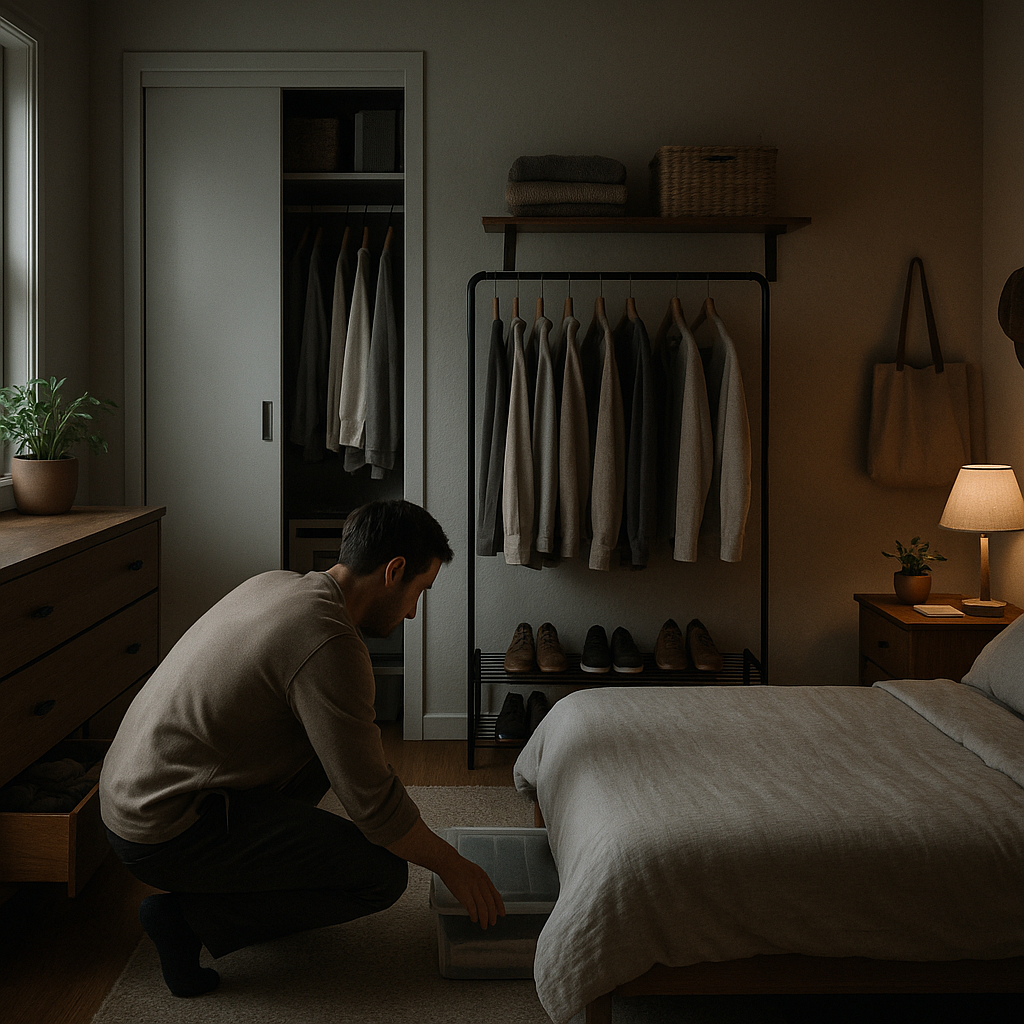
A small bedroom with a tiny closet can feel like a daily negotiation: where do the off-season sweaters go, why is the floor always covered in shoes, and how does a room this size generate so much clutter? The good news is that limited square footage isn’t actually the problem. The problem is almost always too much stuff competing for too little well-designed space. Once you fix both halves of that equation, even a cramped room with a single narrow closet can feel calm and functional.
This guide walks through the exact order I’d tackle it in—declutter first, then build storage upward and underneath, then make the closet itself work harder, and finally set up a rhythm so it stays that way. Follow it in sequence and you’ll get far better results than buying a pile of bins and hoping for the best.
Start by removing what shouldn’t be there
The single most effective thing you can do in a small bedroom costs nothing: take stuff out. Organizing clutter just rearranges your frustration. The goal is to return only what you actually use and genuinely want in the room.
The trick is to work in small, finishable sections so you don’t burn out or end up with a worse mess than you started with. Don’t dump your entire closet on the bed at 9 p.m.—that’s how people give up halfway through. Instead, pick one drawer, one shelf, or one section of hanging clothes and finish it completely before moving on.
A simple decluttering pass that works
- Clear the surfaces first. Nightstands, dressers, and windowsills are clutter magnets. Remove anything that doesn’t belong in a bedroom—dishes, paperwork, random electronics—and relocate it.
- Go category by category. Pull every item in one group (say, all your T-shirts) and handle them together. It’s much easier to make decisions when you can see you own fourteen of the same thing.
- Keep only what you use or love. If you haven’t worn it in a year and it doesn’t fit your life, it’s just taking up space you can’t afford.
- Question whether it even belongs in this room. Could blazers hang in an entry closet? Could rarely-worn shoes live by the front door or in the garage? Relocating whole categories elsewhere is one of the fastest ways to free up a small closet.
Decluttering before you organize isn’t optional busywork—it’s what makes every step that follows simpler and more effective. You can’t design good storage around an unknown quantity of belongings.
Build storage upward, not outward
In a small room, floor space is your scarcest resource, so your storage strategy should climb the walls instead of spreading across the floor. Vertical space is almost always underused.
Look at the empty real estate above your dressers, above the door, and in the gap between your top shelf and the ceiling. A few well-placed shelves can hold books, folded items, baskets, or decor that would otherwise eat into your nightstand and dresser tops.
- Wall shelves above the dresser or bed create storage without consuming a single inch of floor.
- An over-the-door organizer is ideal for shoes, accessories, scarves, or small items—it uses a surface that’s otherwise completely wasted. Hang one on the bedroom door or the closet door.
- Hooks on the back of the door or on a free patch of wall hold bags, robes, tomorrow’s outfit, or a hat collection.
- Baskets on a high shelf corral the lightweight, less-used things—spare bedding, off-season accessories—and look tidy doing it. Woven baskets keep an open shelf from feeling chaotic.
The principle to remember: every vertical surface is potential storage. Doors, the wall above furniture, and the air above your closet rod are all fair game.
Put the space under your bed to work
Under-bed storage is the secret weapon of the small bedroom, because it’s a large flat area you’re already paying for and probably ignoring. It’s the natural home for anything you don’t reach for daily.
This is the perfect spot for out-of-season clothing. Storing winter coats and sweaters under the bed during summer (and vice versa) effectively doubles your usable closet by removing half your wardrobe from competition. Flat under-bed bins or rolling drawers keep everything contained and dust-free.
One word of caution from experience: skip the vacuum-seal compression bags for clothes you care about. They save space, but garments come out badly wrinkled, and you’ll spend more time and money pressing them than the storage was worth. Stick to flat bins that let clothes lie naturally.
If your bed sits low to the ground, bed risers can buy you several extra inches of clearance—enough to fit proper storage boxes underneath.
Choose furniture that earns its footprint
When space is tight, every piece of furniture should do at least two jobs. A bed is just a bed; a bed with drawers is a dresser too. The smartest small-bedroom moves replace single-purpose items with double-duty ones.
Multi-tasking pieces worth considering
- A small dresser as a nightstand. Instead of a tiny table that only holds a lamp, use a compact chest of drawers beside the bed. You get a surface and hidden storage in the same footprint.
- A storage bench at the foot of the bed. It holds extra blankets or bulky items, gives you a place to sit while dressing, and tucks neatly against the bed frame.
- A storage ottoman. Doubles as seating and a hidden bin for whatever doesn’t have a home yet.
- A bed frame with built-in drawers. If you’re buying a new bed anyway, this is the highest-value storage upgrade in the room.
The mindset here is simple: when space is scarce, tuck storage into everything you can. You don’t need a separate piece for each function—you need pieces that combine functions.
Make a tiny closet hold more
A small closet rewards creativity. The goal is to find every usable inch—high, low, and side to side—and give each category of items a defined home so things stop turning into a jumbled pile.
Reclaim the height
Most closets waste vertical space. If you can move your clothes rod up a few inches, you’ll free up valuable room below for drawers or shelves. Add a shelf above the hanging area (or above the existing top shelf) for items you rarely touch. Down low, slide in open shelves or small drawers beneath shorter hanging garments like shirts and skirts—that dead space below them is prime storage.
Switch to slim hangers
This one small change makes a visible difference. Bulky plastic and wooden hangers crowd the rod; swapping to thin, non-slip velvet hangers lets you fit noticeably more clothing in the same width while keeping everything neat and aligned. It also stops shoulders from slipping off and creating that floor pile.
Give shoes a defined home
A shoe organizer—whether a hanging over-the-door style, a low shelf, or a rack on the closet floor—means each pair has a spot. When shoes have a designated home, you’re far less likely to kick them into a heap at the end of the day. Tidiness is mostly about reducing the friction of putting things away.
Free-fold to lighten the rod
If you have any spare room in your dresser, file-fold clothes (the KonMari method, where items stand upright on their edge rather than stacked flat). You’ll see everything at a glance, fit more per drawer, and can move some folded categories out of the closet to free up hanging space where it matters.
Keep it that way with a seasonal reset
Even the best-organized small bedroom drifts back toward clutter without a maintenance habit. The most practical rhythm for most people is a seasonal reset—roughly three to four times a year.
A reset is when you rotate your wardrobe: out-of-season clothes go into under-bed bins or a storage area like a closet shelf, basement, or garage, and the current season’s items come forward into easy reach. This single move keeps your closet from holding twice the clothing it should at any given time.
Pair the rotation with a quick decluttering pass. Because you’re already handling everything as you swap it, it’s the natural moment to pull out what you didn’t wear last season and let it go. A printable decluttering checklist or calendar can keep you honest if letting go is hard for you.
- Swap in-season and off-season clothing between the closet and under-bed storage.
- Cull anything you skipped over entirely last season.
- Reset surfaces—clear the dresser top and nightstand back to essentials.
- Refresh systems—wipe down shelves, empty the catch-all basket, and make sure every category still has a home.
The bottom line
A small bedroom with limited closet space isn’t a storage problem so much as a too-much-stuff problem dressed up as one. Declutter first so you know exactly what you’re working with, then climb the walls and use the floor beneath your bed, choose furniture that does double duty, and squeeze every inch out of the closet with raised rods, slim hangers, and a real home for your shoes. Finish by locking in a seasonal reset so the system maintains itself. Start with a single drawer or shelf this week—that small, finished win is what makes the rest of the room feel possible.