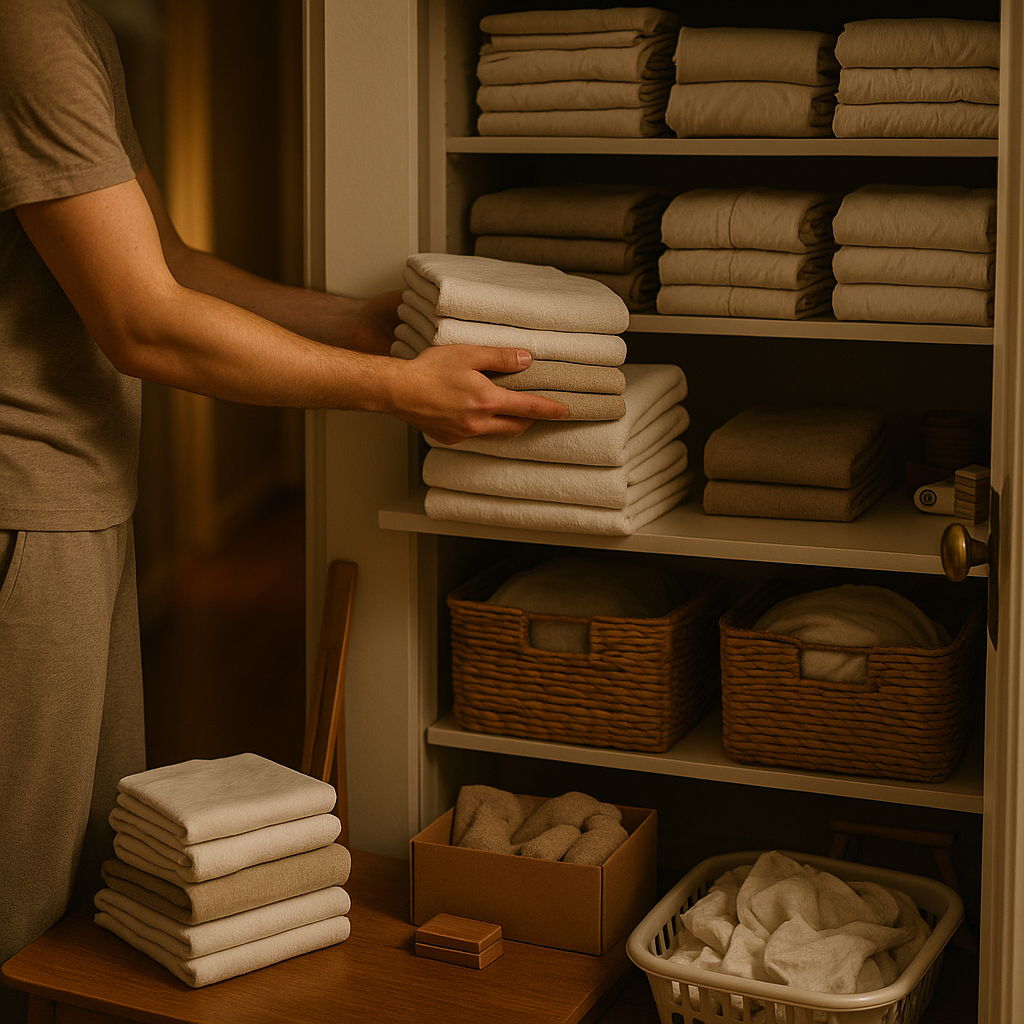
The linen closet is one of those spaces that quietly descends into chaos. It starts innocently enough—a folded set of sheets here, a spare bottle of shampoo there—and within a year you’re shoving a wad of mismatched pillowcases against the door just to get it closed. The problem isn’t that you own too much (though you might); it’s that the closet has no system, no logic, and no boundaries.
The good news is that a linen closet is one of the most satisfying spaces to organize because it’s small, contained, and the rules are simple once you know them. This is a project you can finish in a single afternoon, and the payoff—grabbing a clean towel without an avalanche—lasts for months. Here’s exactly how to do it, step by step.
Start by Emptying the Entire Closet
It’s tempting to “tidy in place”—straightening stacks and nudging things into corners. Resist that urge. You cannot organize a space you can’t fully see, and half-finished sorting almost always recreates the original mess.
Pull everything out and lay it on a bed or the floor nearby. As you empty the shelves, you’ll likely uncover items that have no business being there in the first place: holiday decorations, random electronics, gift bags, that bin of stuff you meant to take to the basement. Set those aside immediately—getting non-linen-closet items out of the equation is half the battle.
Wipe down the empty shelves while you’re at it. You may never see them this bare again, so take advantage of the clean slate.
Sort Ruthlessly Into Keep, Donate, and Toss
Now go through every single item and make a decision. The most common mistake here is keeping things “just in case.” Linens are bulky, and storage space is the real cost of hanging onto items you’ll never use.
As you sort, be honest about the condition of your textiles. Threadbare towels, faded sheets, and pilled blankets aren’t doing you any favors. Worn-out towels can be repurposed as cleaning rags or donated to animal shelters, which often accept them gratefully.
What to actually let go of
- Sheet sets missing pieces. A fitted sheet with no matching flat sheet or pillowcases is dead weight. Match your sets as you sort and note what’s incomplete.
- Towels that are stiff, frayed, or stained beyond rescue. If you wouldn’t hand it to a houseguest, it’s not earning its shelf space.
- Sizes you no longer own. Got rid of the twin bed two years ago? The twin sheets can go too.
- Expired or empty toiletries and medicine. If your linen closet doubles as a backup bathroom cabinet, this is where a shocking amount of clutter hides—old prescriptions, dried-up lotions, hotel shampoos you’ll never use.
- Excess quantity. You don’t need eight sets of sheets per bed. Two to three per bed is plenty for most households.
Categorize Everything Before It Goes Back
This is the step that separates a closet that looks organized from one that stays organized. Before you put anything back, group your keep pile into clear categories.
For linens specifically, sort by size and type: King, Queen, Full, and Twin sheets in their own stacks, then bath towels, hand towels, washcloths, and blankets each in their own group. If you’ve been struggling to find matching sets, this sorting moment is where you’ll finally see what you have and what’s gone astray.
For everything else, think in terms of function: a group for medicine, a group for extra toiletries and soaps, a group for backup toilet paper and paper towels, a group for guest supplies. You’re essentially building “zones” before you’ve even touched a shelf.
A quick tip for keeping sheet sets together
One of the oldest and best tricks in the book: fold a complete sheet set and tuck the whole bundle inside one of its own pillowcases. Now the set lives as a single unit—no more orphaned fitted sheets, no more mystery of the disappearing pillowcase.
Assign Zones and Use Bins to Contain Small Items
Now you’ll put everything back, but with intention. Think about how you reach into the closet and what you grab most often.
The principle is straightforward: store things where it makes sense to use them. Items you reach for daily or weekly go at eye level and on the easiest shelves. Things you rarely touch go up high or down low.
- Top shelves: Bulky, infrequently used items—extra pillows, seasonal blankets, spare comforters. These are out of the way but still accessible when guests arrive.
- Middle shelves (the prime real estate): Your everyday towels and the sheet sets you use most. This is the zone you reach without thinking, so reserve it for daily life.
- Lower shelves: Heavier bins and bulk supplies. A basket of loose toilet paper rolls works beautifully on a bottom shelf—pull the rolls out of their plastic packaging first so they stack neatly and look tidier.
Bins and baskets are your best friends
Loose small items are what turn a closet into a junk drawer. The fix is to corral them. Pull medicine, soaps, and toiletries out of their bulky retail packaging and group each category into its own labeled basket—one for medicine, one for backup toiletries, one for washcloths, and so on. When you want something, you pull out the whole basket, take what you need, and slide it back. Nothing slumps over or migrates.
Fabric bins work especially well for sheet sets. Labeling each bin by size—”Queen,” “King”—means you (and anyone else in the house) can grab the right set instantly without unfolding three wrong ones first.
Consider a Unified Look (and Why It Helps)
This part is optional, but it has a practical payoff beyond aesthetics. A linen closet where everything matches isn’t just prettier—it’s easier to maintain.
Many organizers swear by sticking to all-white sheets and towels. The reasoning is genuinely functional: white linens can be bleached without worrying about fading or staining, they always coordinate regardless of which set you grab, and a uniform palette makes the whole closet read as calm rather than cluttered. If you’ve ever stared at a jumble of mismatched colors and patterns, you know how visually noisy that is.
You don’t have to go fully white to get the benefit. Choosing a simple, cohesive theme—matching baskets, a consistent color story, uniform bins—creates a sense of order that makes the space feel maintained even when it’s not perfectly tidy. The visual consistency does a lot of quiet work.
Make the Top Shelves Reachable and the System Sustainable
An organized closet only stays organized if it’s easy to use. If your top shelf requires a treasure hunt for a step stool every time, you’ll start dumping things on lower shelves instead—and the system breaks down within weeks.
A small, foldable step stool stored right inside the closet solves this elegantly. It takes up almost no space and means the top shelves stay genuinely usable rather than becoming a no-man’s-land where things go to be forgotten.
Keep it from sliding back into chaos
The single most important habit for a lasting linen closet is the periodic edit. Every couple of months, do a quick pass through your toiletries and medicine—toss the expired and empty, and you’ll prevent the slow accumulation that wrecks the space over a year. It takes five minutes and saves you from ever needing a full overhaul again.
A few more habits that keep the system intact:
- Refold and return. When laundry comes out of the dryer, fold it the same way every time and put it back in its assigned zone immediately.
- One in, one out. Buy a new set of towels? Retire an old set the same day.
- Respect the bins. If a basket is full, that’s your signal to declutter that category—not to start a new pile on top.
- Keep labels visible. Labels aren’t just for show; they tell everyone in the household where things belong, which means the burden of tidiness doesn’t fall on you alone.
The Bottom Line
Organizing a linen closet comes down to five moves: empty it completely, sort honestly into keep–donate–toss, group what’s left into clear categories, assign zones with bins to contain the small stuff, and build in the habits that keep it that way. The bulky, rarely-used items go up high; your everyday towels and sheets claim the easy-to-reach middle; and a couple of labeled baskets tame everything that used to roam free.
Start this weekend by simply pulling everything out and matching your sheet sets—you’ll be surprised how much clarity that one step gives you. From there, the rest of the system practically builds itself, and you’ll have a closet that closes easily, looks calm, and actually stays that way.