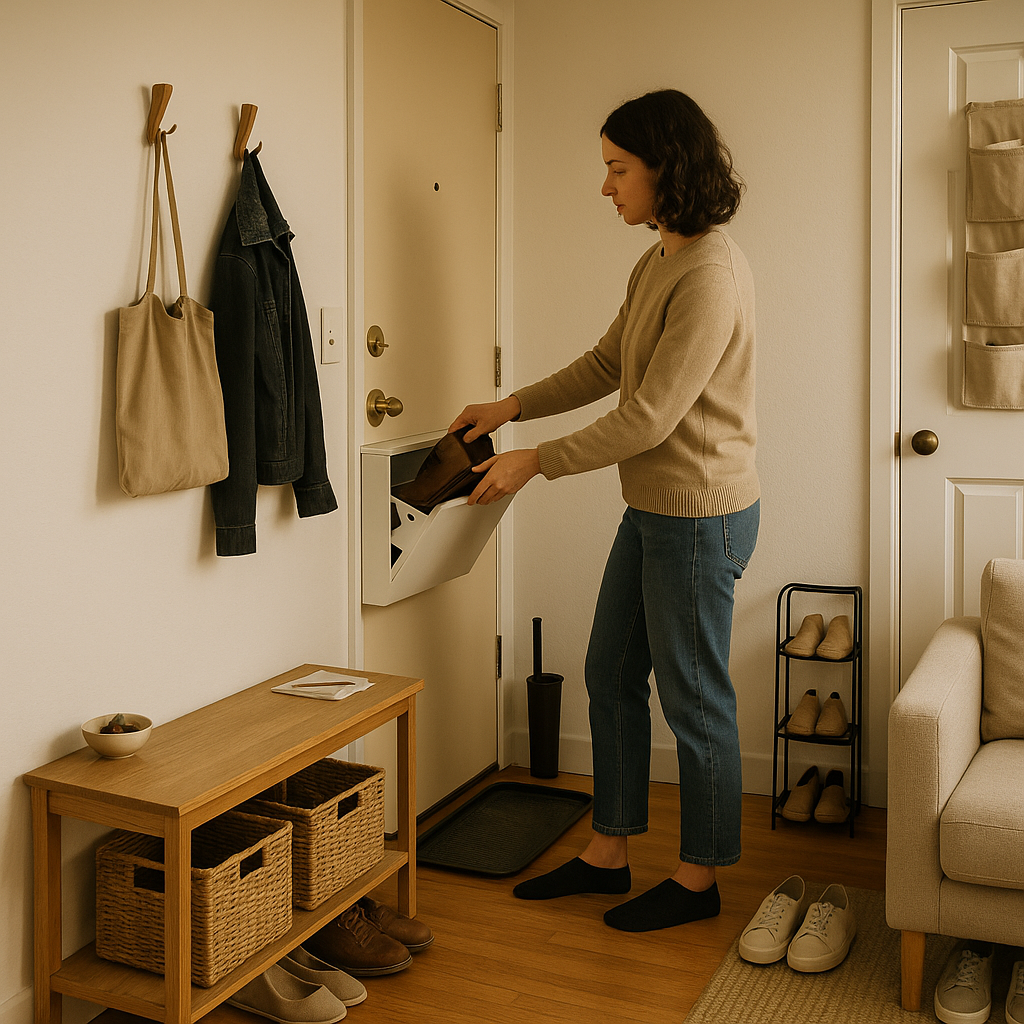
If your front door opens directly into your living room, your kitchen, or a hallway barely wide enough to turn around in, you already know the problem: shoes have to go somewhere, and that somewhere usually ends up being a growing pile by the door. Without a dedicated entryway, footwear creeps into every room, trips you on the way out, and makes even a tidy home feel chaotic the moment you walk in.
The good news is that you don’t need an entryway to have a calm, organized shoe situation. You need a system that uses the space you actually have — walls, under-bed gaps, closet interiors, and a few square feet of floor — and a habit that keeps shoes from multiplying. Here’s how to build both.
Start by deciding what actually lives near the door
The biggest mistake people make in small spaces is trying to store all their shoes in one spot near the entrance. You don’t need to. The shoes that need to be accessible at the door are the ones you reach for daily — your commuting pair, your everyday sneakers, the slip-ons you grab for the dog. That’s usually three to five pairs per person, not your entire collection.
Everything else — seasonal boots, dressy heels, hiking shoes, the sandals you wear twice a summer — can be stored elsewhere in the home, even somewhere less convenient. Separating “active” shoes from “stored” shoes instantly shrinks the problem you’re trying to solve at the door.
Before you buy a single organizer, do a quick declutter. Pull every pair you own into one place and be honest:
- Toss or recycle anything broken, painfully uncomfortable, or worn past repair.
- Donate shoes you haven’t worn in a year and won’t miss.
- Keep what you genuinely wear, then sort those into “daily” and “occasional.”
It’s far easier to organize 15 pairs than 40. The decluttering step is the one most people skip, and it’s the one that makes every storage solution below actually work.
Go vertical: use the walls and the back of your door
When floor space is the thing you don’t have, the answer is almost always up. Vertical storage gives you a home for daily shoes without sacrificing the walking path you need by the entrance.
Over-the-door racks
An over-the-door shoe organizer is the single most underused tool for entryway-less homes. It hangs on the back of any standard door — your front door, a coat closet, even a bathroom door near the entrance — and holds anywhere from 12 to 24 pairs depending on the design. Pocketed fabric versions are great for flats, sneakers, and kids’ shoes; wire or metal over-door racks handle bulkier footwear better and don’t sag over time.
The trick is choosing the right door. If your front door swings against a wall, the back of it is prime real estate. If not, a nearby closet door works just as well.
Wall-mounted racks and shoe ladders
A leaning shoe ladder is one of the more stylish options out there — it props against the wall, takes up almost no floor footprint, and turns a row of shoes into something that looks intentional. Wall-mounted rails or angled shelves do the same thing while keeping the floor completely clear, which makes vacuuming and mopping far easier.
If you rent and can’t drill, look for tension-mounted or adhesive-backed options, and keep the weight light — these hold a few pairs of flats or sneakers, not a stack of winter boots.
Tall rotating or tiered racks
For small and studio apartments, a tall rotating shoe rack is a clever pick because it stores upward instead of outward. You get multiple tiers in a footprint not much larger than a single pair of shoes, and the spin makes it easy to see everything. Multi-tier vertical racks tucked into a corner do the same job at a lower price point.
Hide shoes in furniture you already need
When you have no entryway, your best storage often disguises itself as something else. The goal is dual-purpose furniture: pieces that earn their footprint by doing two jobs at once.
- Storage benches: A bench with a lift-up seat or cubbies underneath gives you a place to sit while you put shoes on and a place to stash them. Position it against the wall closest to your door, even if that’s technically in your living room.
- Storage ottomans: If a bench feels too utilitarian for a living room, an upholstered storage ottoman blends in as furniture while quietly holding several pairs inside.
- Stackable shoe cabinets: Slim-profile shoe cabinets — sometimes called shoe dressers — tilt shoes into shallow drawers, so they project only a few inches from the wall. They’re ideal when you want shoes fully hidden and the surface up top doubles as a spot for keys and mail.
- Console tables with baskets: A narrow console against a wall, with two or three large baskets tucked underneath, creates an instant “drop zone” that looks deliberate rather than messy.
Baskets deserve a special mention. A couple of large, sturdy baskets by the door are the lowest-effort solution that exists — shoes go in, the visual clutter disappears, and there’s no fiddling with slots or pockets. They’re especially forgiving for families and kids who won’t reliably line shoes up on a rack.
Reclaim the spaces you’re not using
The shoes that don’t need to live by the door can go almost anywhere — and most homes have hidden capacity people never think to use.
Under the bed
The gap under your bed is some of the most wasted storage in the house. Flat under-bed bins on wheels or shallow shoe boxes slide right in and keep off-season and occasional pairs out of sight but easy to retrieve. Clear bins or labeled boxes save you from dragging everything out to find one pair. If your bed sits low, bed risers can create the few extra inches you need.
An underused closet
If you have a coat closet, linen closet, or spare closet that’s only half-full, it can become a dedicated shoe zone. Add a tension rod with hanging shoe pockets, stack shoe cubbies on the floor, or fit a small tiered rack inside. Even claiming the floor of an existing bedroom closet for your stored shoes frees up the entry area for daily pairs only.
Unexpected gaps
Look for the dead spaces most people ignore. A pair of slim shoe stands tucked under a window ledge, a narrow rack beside the sofa, the empty stretch under a console or radiator shelf — these awkward spots are perfect for low-profile shoe storage precisely because nothing else fits there. The point is to spread shoes across several small, out-of-the-way places rather than forcing them all into one overcrowded spot.
Build a habit so the system actually sticks
Storage solves the where, but habits solve the why does this keep happening. The best rack in the world fails if shoes never make it into it.
- Make the daily spot effortless. The easier it is to put shoes away, the more likely it happens. A basket you toss into beats a rack you have to align perfectly — especially for kids and anyone in a hurry.
- Set a hard limit. Decide how many pairs are allowed in the entry zone (say, two per person). When it overflows, that’s your cue to relocate a pair to under-bed or closet storage.
- Do a 30-second reset. Once a day — ideally before bed — put stray shoes back. It takes under a minute and stops the pile from ever forming.
- Rotate seasonally. Twice a year, swap stored and active shoes so your prime door space always holds what you’re actually wearing now.
One more practical note: keep wet or muddy shoes off fabric and wood. A simple boot tray or a washable mat near the door catches drips and protects your floor and your storage furniture, which matters a lot more when your “entryway” is really the corner of your living room.
Common mistakes that keep small-space shoes messy
A few patterns sabotage even good intentions. Watch for these:
- Buying storage before decluttering. You’ll size your solution to a collection you should have shrunk first.
- Choosing storage that’s too fiddly. If putting a shoe away takes effort, it won’t happen consistently.
- Trying to store everything at the door. Spread the load across the home instead.
- Ignoring vertical and hidden space. Floor space is your scarcest resource — use walls, doors, and under-bed gaps first.
- No designated landing spot. Without a clear “shoes go here,” they go everywhere.
The bottom line
You don’t need an entryway to keep shoes under control — you need a plan that matches your actual space. Start by decluttering, then keep only your daily pairs near the door using a bench, baskets, or an over-the-door rack. Push everything else into vertical and hidden storage: the back of a door, under your bed, a wall-mounted ladder, or an underused closet. Finally, protect the system with a 30-second daily reset and a firm cap on how many pairs live by the entrance.
Pick one solution from this article — even just adding two baskets by the door tonight — and build from there. A tidy entry zone in a home that doesn’t technically have an entry is entirely within reach.