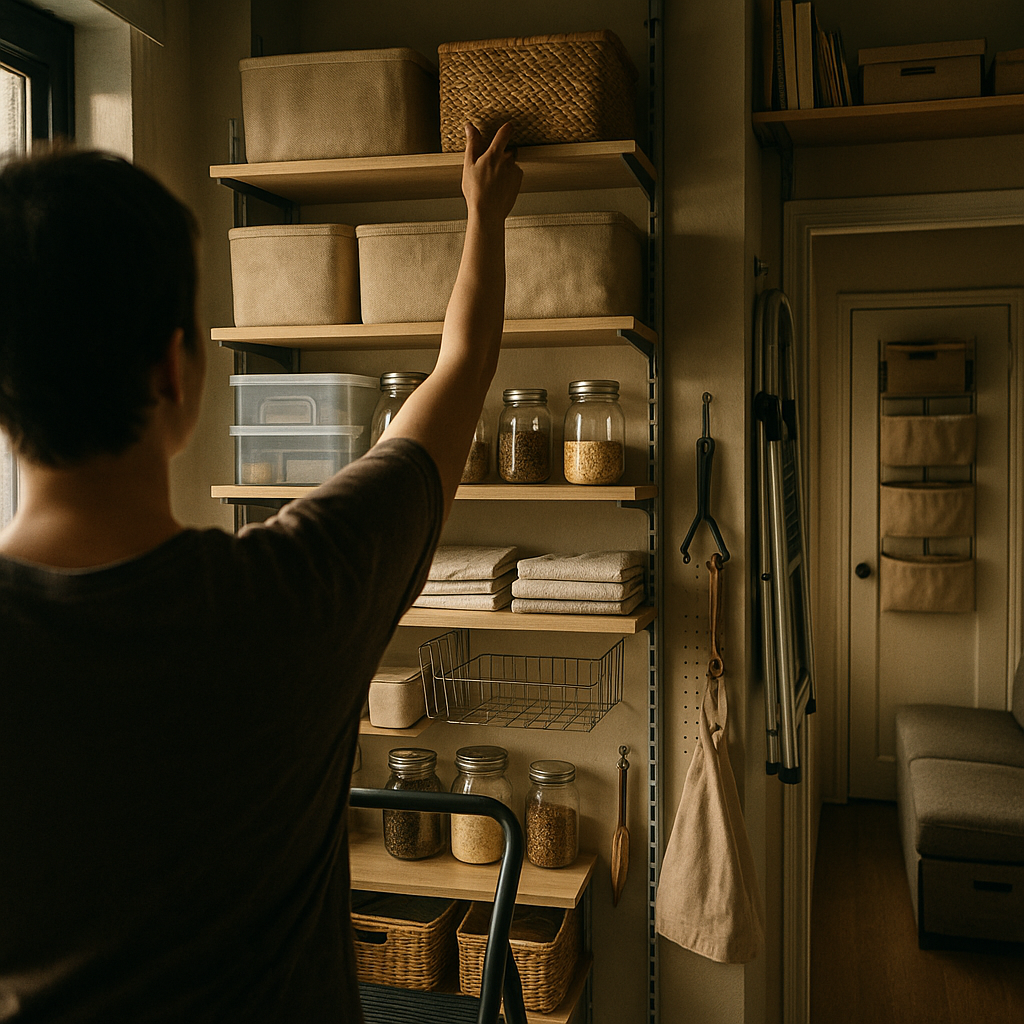
Most small rooms aren’t actually short on storage — they’re short on used storage. When floor space runs out, we tend to stop looking, even though there’s usually three or four feet of empty wall above every surface in the room. That blank vertical real estate is the single most underused asset in a small home, and learning to fill it intentionally is what separates a cramped room from a calm one.
The principle is simple: when you can’t go out, go up. But doing it well takes more than nailing a shelf to the wall and hoping for the best. Below is a practical, room-tested approach to turning vertical space into genuine, everyday storage — without making your walls look like a hardware aisle.
Start by reading the room from floor to ceiling
Before you buy a single organizer, spend five minutes looking at your room the way a storage planner would. Stand in the doorway and mentally divide each wall into three zones: low (floor to about knee height), middle (the prime, easy-reach zone), and high (above shoulder height). In most small rooms, the middle zone is crammed and the high zone is completely empty.
Your goal is to move infrequently used items up so the prime middle zone stays clear for the things you reach for daily. A few questions that make the plan obvious:
- What do I use every day? Keep it in the easy-reach middle zone.
- What do I use a few times a month? Push it high or low.
- Where is there empty wall above a piece of furniture? That’s a shelf waiting to happen.
- Which doors are doing nothing but opening and closing? Every one is a potential storage surface.
This quick audit prevents the most common mistake: buying vertical storage and then realizing it doesn’t fit your habits, so it sits empty while clutter piles up around it.
Shelves: the workhorse of vertical storage
Shelving is the highest-impact change you can make in a small room, because it adds usable square footage without taking up any floor at all. The trick is choosing the right type for the spot.
Floating shelves for clean, flexible walls
Floating shelves have no visible brackets, so they read as light and intentional rather than cluttered — important in a small space where heavy fixtures shrink the room visually. Mount one or two above a desk, nightstand, or sofa to hold books, a plant, or a small bin of supplies. Keep the depth modest (around 6 to 8 inches is plenty for most items) so the shelf doesn’t jut into the walkway or bonk anyone on the head.
One nuance people miss: group your floating shelves rather than scattering single shelves across multiple walls. A tidy cluster on one wall feels designed; lone shelves on every wall feel chaotic and make a small room feel busier than it is.
Closet shelves above the clothes bar
Small bedrooms almost always come with small closets, and the easiest fix is adding a shelf or two above the existing clothes rod. That dead space at the top of the closet can hold folded sweaters, off-season clothing, or labeled bins for things you rarely touch. If you store items up there in matching bins with front-facing labels, you keep the visual calm and you never have to dig.
Ladder shelves and tall narrow units
When you do have a little floor to spare, choose furniture that’s tall and narrow rather than wide and low. A ladder shelf or a slim bookcase uses a small footprint but climbs high, multiplying storage in the exact direction you have room to spare. Anchor any tall unit to the wall — in a small room it’s often near a bed or seating, and tip-overs are a genuine hazard.
Put your doors and walls to work
Doors are flat, vertical, and almost always wasted. The same goes for big empty stretches of wall. These are the cheapest wins in the whole strategy.
Over-the-door organizers
An over-the-door organizer instantly creates a wall of small compartments on a surface that was doing nothing. They’re not just for shoes — the clear-pocket versions are excellent for:
- Cleaning supplies and spray bottles on a utility closet door
- Craft and office odds and ends
- Toiletries and travel-size bottles inside a bathroom door
- Snacks or pantry packets on a kitchen door
- Accessories, socks, or scarves on a bedroom closet door
Choose one with a rigid frame or a fitted bracket if your door gets a lot of slamming, since loosely hung organizers swing and bang.
Hooks — the most underrated tool you own
A few hooks on a wall is one of the simplest ways to store things vertically, and adhesive hooks like Command hooks work for far more than picture frames. Use them to hang bags, hats, headphones, robes, dog leashes, jewelry, kitchen utensils — anything with a loop or handle. Because they require no drilling, they’re ideal for renters and for testing a placement before committing to a permanent fixture.
The pro move is to hang things you’d otherwise pile. A tote bag on a hook is off the floor; the same bag dumped on a chair becomes the seed of a clutter pile.
Pegboards for endless flexibility
If you have a craft corner, a home office, a garage, or a hardworking kitchen wall, a pegboard turns a flat surface into fully customizable storage. The beauty is that you can rearrange hooks, baskets, and bins as your needs change — nothing is locked in. You don’t need a giant wall, either; even a modest pegboard mounted above a desk can hold supplies, free up drawer space, and double as decoration. Group items by category and leave a little breathing room so the board stays useful rather than overwhelming.
Stack up inside cabinets, drawers, and shelves
Vertical thinking shouldn’t stop at the walls. The empty air inside your cabinets and drawers is prime territory, and it’s where small items quietly waste the most space.
Stacking drawers and risers
Under a kitchen sink or inside a deep cabinet, a single layer of items leaves a tall, hollow space above it. Acrylic or plastic stacking drawers let you store two or three layers in the same footprint — instantly doubling or tripling capacity — while keeping smaller items contained and easy to pull out. The same logic applies to shelf risers in cabinets and pantries: a riser creates a second tier so the back row isn’t buried behind the front.
Vertical filing instead of stacking
Counterintuitively, one of the best vertical tricks is to store flat items upright. File your cutting boards, baking sheets, and pan lids vertically in a rack so you can grab one without unstacking the whole pile. Do the same with folded clothing in a drawer — stand the items on edge like files so you can see every one at a glance. It’s “vertical” in the sense that you’re using the depth of the drawer as height.
Don’t forget the space under and over the bed
In a small bedroom, the bed is the biggest single object — and it hides two excellent storage zones.
Under the bed is ready-made for low, flat storage. Use shallow rolling bins or under-bed boxes for off-season clothes, extra linens, or shoes. Lidded or zippered containers keep dust out, and bins on casters slide in and out without crawling. If your frame sits low, bed risers lift it a few inches and unlock more clearance — a cheap upgrade that pays off immediately.
Above the bed is the high zone again: a single floating shelf or a slim cabinet mounted well above the headboard can hold books and decor that would otherwise eat up nightstand space. Just keep anything heavy off the wall directly over where you sleep.
Common mistakes that undo all your effort
Going vertical works beautifully until a few predictable errors creep in. Watch for these:
- Overfilling the walls. Vertical storage should reduce visual noise, not add to it. Leave some blank wall so the room can breathe.
- Storing daily items too high. If you need a step stool every morning, the system will fail. Reserve high zones for occasional-use items.
- Skipping labels and containers. Open shelves full of loose stuff read as clutter. Bins and labels keep high storage looking deliberate.
- Ignoring weight limits. Adhesive hooks and lightweight shelves have real limits; overload them and you’ll be patching drywall.
- Treating it as one-and-done. Even the best system needs a regular reset. Do a quick weekly pass to return things to their spots and clear accumulating clutter before it spreads.
The bottom line
Small rooms feel cramped not because they lack storage, but because all the storage lives in the same crowded zone. The fix is to spread your belongings across the full height of the room — up onto shelves, onto doors and walls, into the stacked layers inside your cabinets, and under the bed — so the easy-reach middle stays clear and calm. Start with a single high-impact move this week: add one shelf above a doorway or desk, hang a row of hooks, or drop a stacking drawer set under the sink. Then keep a short weekly reset on the calendar so the vertical space you reclaimed stays working for you instead of quietly filling back up.