There’s a specific kind of dread that comes with a messy house and almost no time to deal with it. Someone texts that they’re stopping by in 45 minutes, or you simply can’t take another evening of stepping over clutter on your way to the couch. Speed cleaning exists for exactly these moments — it’s the art of making your home look and feel dramatically better in a short, focused burst, rather than waiting for the mythical free weekend that never arrives.
But speed cleaning isn’t about scrubbing faster or cutting corners until your home falls apart. It’s about working in the right order, focusing on the changes that deliver the biggest visual payoff, and building a few repeatable habits so the mess never gets overwhelming again. This guide walks you through the mindset, the method, and a room-by-room game plan you can actually finish before the doorbell rings.
What speed cleaning actually means (and what it doesn’t)
First, a useful distinction. Decluttering, cleaning, and organizing are three different jobs, and speed cleaning only involves two of them. Decluttering is deciding what stays and what goes. Organizing is giving everything you keep a logical home. Cleaning is dealing with dirt — wiping, sweeping, scrubbing. As one professional organizer puts it, you can only truly organize after you’ve decluttered, because that’s when the empty space to work with finally appears.
Speed cleaning leans on the cleaning side, plus a fast pass of “putting away” rather than true organizing. You’re not making lifelong keep-or-toss decisions in a 30-minute sprint — that’s emotional, time-consuming work best saved for a dedicated session. During a speed clean, your job is simpler: get surfaces clear, get dirt gone, and get the room reading as calm. The deeper decluttering can come later.
Why does this matter? Because the most common speed-cleaning mistake is opening a drawer, finding a pile of mystery items, and disappearing down a decision rabbit hole for 20 minutes. Speed cleaning means you keep moving. Anything that requires a real decision gets set aside, not solved.
The five principles that make cleaning fast
Before you touch a sponge, internalize these. They’re the difference between frantic and efficient.
- Top to bottom, dry to wet. Dust and crumbs fall downward, so clean high surfaces before low ones, and do dry tasks (dusting, clearing clutter) before wet ones (wiping, mopping). Otherwise you’ll re-dirty floors you just cleaned.
- One direction around the room. Pick a corner and work clockwise. This stops you from crisscrossing, forgetting spots, or cleaning the same surface twice.
- Clear before you clean. You can’t wipe a counter buried in clutter. Removing the stuff first is usually 70% of what makes a room look transformed.
- Don’t leave the room mid-task. Every trip to put one item away in another room is a chance to get distracted. Use a basket or laundry hamper to collect everything that belongs elsewhere, and deal with it all at the end.
- Set a timer. A 15- or 20-minute timer creates urgency and prevents the perfectionism that turns a quick tidy into a three-hour deep clean.
Your essential speed-cleaning kit
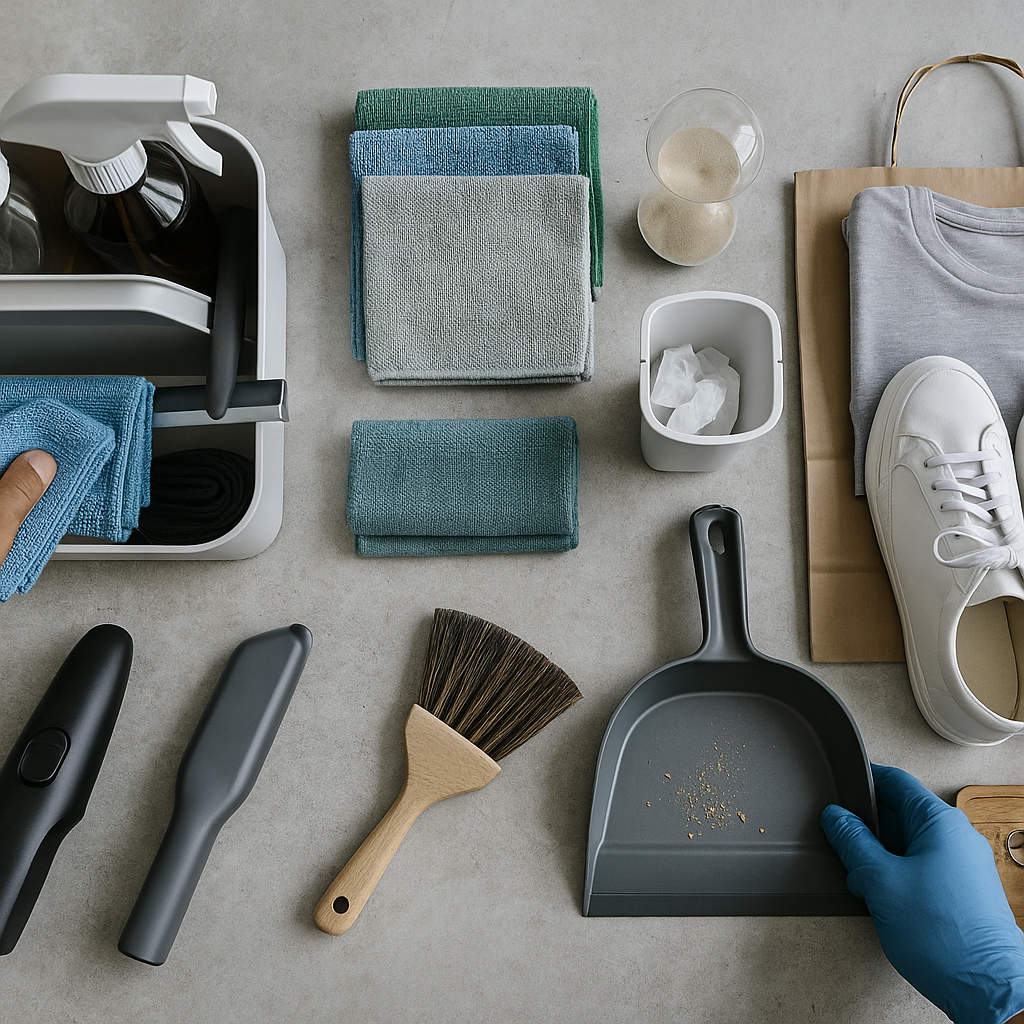
Half the battle is not wasting time hunting for supplies. Assemble a simple caddy you can grab and carry from room to room. You don’t need a cabinet full of specialty products — a few versatile basics outperform a dozen single-use sprays.
- An all-purpose spray cleaner for most surfaces
- A glass cleaner for mirrors and windows
- A stack of microfiber cloths (they trap dust without chemicals and dry streak-free)
- A bathroom cleaner or, in a pinch, dish soap — it cuts grease surprisingly well on tubs and sinks
- A roll of paper towels for the jobs you don’t want touching your good cloths
- One large basket or empty laundry hamper for the “belongs elsewhere” pile
- A trash bag and, ideally, a second bag for recycling
Keep this caddy stocked and stored somewhere central. The simple act of not having to gather supplies shaves real minutes off every session.
The 30-minute whole-home blitz
This is the routine for the “guests are coming” scenario, where you want the maximum visible improvement in the minimum time. The trick is to focus only on the rooms and surfaces people actually see and use, in a sequence that builds momentum.
Minutes 0–10: The grab-and-clear sweep
Walk through your main living areas with your basket and trash bag. Move quickly. Toss obvious garbage, drop dishes by the sink, and put anything that belongs in another room into your basket. Don’t organize the basket — just collect. Clear every flat surface you can: coffee table, kitchen counter, entryway table. A clear surface reads as “clean” to the human eye even before you’ve wiped it. This single step does more visual work than anything else you’ll do.
Minutes 10–20: Wipe and shine the high-impact spots
Now that surfaces are clear, spray and wipe the ones that matter most. In the kitchen, that’s the counters, the stovetop, and the sink. In the bathroom, hit the sink, the faucet, and the mirror — a sparkling mirror makes a whole bathroom feel fresh. Wipe down the toilet exterior and give the bowl a quick swish if you have a few seconds. These are the surfaces guests notice and the ones that genuinely affect daily life.
Minutes 20–30: Floors and the final reset
Do a quick floor pass where it counts: a fast vacuum or sweep of the entryway, kitchen, and main walkway. Fluff the couch cushions and fold the throw blanket — soft furnishings looking tidy signals “this room is under control.” Finally, return your basket of collected items to their rooms, distributing them quickly. Empty the trash. Light a candle or open a window if you have one more minute; scent is the finishing touch people register before anything else.
A room-by-room cheat sheet for deeper sessions
When you have a bit more time — say a Saturday morning — you can rotate through rooms more thoroughly. The same top-to-bottom, clear-then-clean logic applies, but you go deeper. Here’s a sensible order and what to prioritize in each space.
Kitchen
Clear and wipe counters, then the stovetop and the front of the microwave. Wash or load any dishes. Wipe the fronts of the most-touched cabinets and appliance handles. Take out the trash and recycling. The kitchen sets the tone for the whole home, so it earns the first slot.
Bathrooms
Bathrooms reward a quick, consistent routine because the work stays small when you do it often. Clear the countertop, wipe the counter and sink, polish the mirror, clean the toilet bowl, seat, and base, and replace hand towels with a fresh set. Restock the toilet paper while you’re there and toss any empty product bottles. Done weekly, this stays a five-minute touch-up rather than a dreaded scrub-down.
Living areas and bedrooms
Clear surfaces, make the bed (it instantly tidies a bedroom), fluff and straighten cushions, and do a quick dust of the surfaces that show it most — coffee tables, nightstands, TV stands. Finish with a vacuum or sweep. Resist the urge to start sorting through the items you find; collect them in your basket and keep moving.
How to keep it clean once it’s clean
Speed cleaning works best as maintenance, not rescue. The reason a house spirals into chaos is usually that small messes never get reset, so they compound. A few lightweight daily habits keep the mess from ever reaching crisis level — which means your speed cleans get shorter and shorter.
- Do an evening reset. Spend ten minutes each night returning things to their homes and clearing the kitchen. Many people who keep tidy homes swear by this single habit. Waking up to clean surfaces makes the whole next day feel manageable.
- Clean as you go. Wipe the counter while dinner cooks. Squeegee the shower after you use it. These near-zero-effort moments prevent buildup that later requires real scrubbing.
- Give everything a home. Clutter accumulates fastest when items have no designated spot. If you keep finding the same things piled on the same surface, that’s a sign those things need a permanent home nearby.
- Tackle decluttering separately. When you do have time for real purging, go by category rather than by room. Gather all of one type of item — say, every coat or every pair of shoes from around the house — and decide together. Starting with things you’re not emotionally attached to builds confidence before you reach the sentimental stuff. This deeper work is what permanently lightens your speed-cleaning load.
Common mistakes that slow beginners down
A few habits quietly sabotage your speed. Watch for these: trying to deep clean and declutter in the same session, which guarantees you’ll run out of steam; cleaning room by room while constantly walking items elsewhere, which scatters your focus; and starting with the hardest, most cluttered space first, which drains your motivation before you’ve built any momentum. Begin somewhere quick and visible — a clear kitchen counter or a made bed gives you the early win that propels you through the rest.
The bottom line
Speed cleaning is less about moving fast and more about moving smart: clear surfaces before you wipe them, work top to bottom and in one direction, keep a stocked caddy within reach, and never leave the room mid-task. Save the big decisions — what to keep, where it lives — for dedicated decluttering sessions done by category. Then layer in a ten-minute evening reset, and you’ll find your home rarely needs rescuing in the first place. Your next step is simple: assemble your caddy tonight, set a 20-minute timer tomorrow, and run the grab-and-clear sweep. The momentum builds from there.