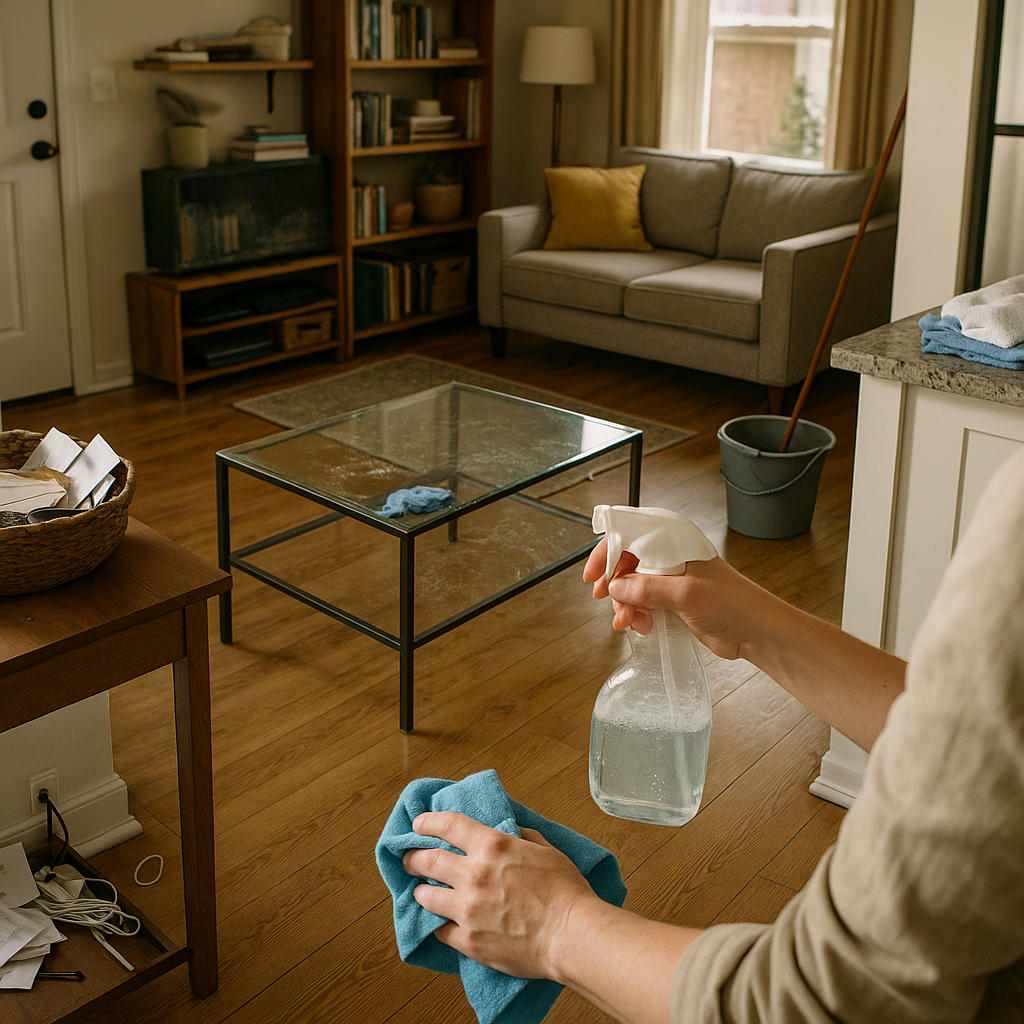
You spent the whole morning cleaning. The counters are wiped, the floors are mopped, the dishes are done — and yet, somehow, the room still feels off. Cluttered. Heavy. Not quite finished. If that frustration sounds familiar, you’re not imagining it. A home can be physically clean and still read as messy, and the gap between those two states usually comes down to a handful of habits that quietly work against you.
The good news: these aren’t signs of laziness or a lack of effort. More often they come from time pressure, picking up a bad habit somewhere along the way, or simply using the wrong approach for the job. Below are five of the most common cleaning mistakes that make a home look messier than it actually is — and the practical fixes that professional cleaners and seasoned organizers rely on instead.
1. Cleaning around clutter instead of clearing it first
This is the single biggest reason a freshly cleaned room still looks chaotic. When you wipe and dust around the stacks of mail, the random chargers, and the “I’ll deal with it later” pile on the dresser, you’re polishing the mess rather than removing it. The surfaces are technically clean, but the eye still registers visual noise everywhere it lands.
There’s an important distinction here that organizers make constantly: decluttering and cleaning are two different jobs, and they have to happen in that order. Organizing — finding a logical home for things and creating a sense of order — can only really work once you’ve cleared the excess and opened up some breathing room. Try to do both at once and you’ll spend twenty minutes shuffling the same objects from one surface to another.
How to fix it
- Clear before you clean. Do a fast pass through the room and remove anything that doesn’t belong there. A labeled basket works beautifully: anything that lives in another room goes in, and you redistribute it at the end instead of breaking your rhythm.
- Work one zone at a time. Empty a surface completely, wipe it down, then return only the things that truly belong on it. A clean nightstand with three intentional items always looks better than a cluttered one that was dusted around.
- Be honest about what earns a spot. If an item has been sitting on the counter for two weeks with no home, the surface isn’t the problem — the missing storage decision is.
2. Not putting things back where they belong
A home stays tidy not because it gets one heroic deep clean a month, but because items consistently return to their assigned spots. When that habit slips, mess accumulates faster than any cleaning session can keep up with. The keys land on the counter, the scissors stay out, the kids’ books migrate to the couch — and within a day or two the room looks “messy” again even though nothing is actually dirty.
This is especially true in households with a lot of incoming stuff: toys, books, art supplies, school paperwork, mail. When your organizational systems drift even slightly off track, things spiral quickly. The fix isn’t more willpower — it’s making the “put it back” step effortless.
Build a system that does the work for you
- Give every high-traffic item a home. If you don’t know where something goes, neither does anyone else in your house. Undecided items become clutter by default.
- Put homes where you actually use things. A drop zone by the door for keys and bags beats a “neater” spot in another room that nobody walks to.
- Do a five-minute reset daily. Tidying a little each day keeps surfaces from becoming overwhelming. Many people find that clear surfaces genuinely calm them — cluttered ones create a low hum of anxiety, and paring down quiets it.
- Close the loop on baskets and bins. If your bins are overflowing or have no labels, the system has outgrown the space, and it’s time to declutter rather than buy more containers.
3. Leaving streaks, film, and residue behind
Sometimes the room isn’t cluttered at all — the cleaning itself just looks bad. Streaky floors, cloudy surfaces, and a hazy film on glass all telegraph “unfinished” even when you’ve put in real effort. And almost always, the culprit is product and technique, not effort.
Where it goes wrong
Two of the most common offenders involve mopping. If your floors dry streaky, the mop head is usually carrying too much water — it needs a harder wring-out before it touches the floor. If the floors dry cloudy or hazy instead, you’ve likely used too much cleaner in the bucket, leaving a residue behind that actually attracts more dirt. More product does not mean more clean; it frequently means more mess.
The same logic applies across the home. Overusing cleaning solution on counters, glass, and wood leaves a sticky or filmy layer that dulls the surface and grabs dust within hours. That dull, slightly dirty look you can’t quite explain is often just leftover product.
- Wring the mop until it’s damp, not dripping. The floor should dry in a minute or two, not stay wet in puddles.
- Dilute according to directions. The recommended amount is calibrated for a reason; doubling it doesn’t double the clean.
- Use a clean, dry microfiber pass on glass and mirrors after your cleaner to lift the last of the film and prevent streaks.
- Change your water when it turns gray. Mopping with dirty water just relocates grime in a thin, streaky layer.
4. Wiping cleaner off too fast (and skipping dwell time)
Here’s a subtle one that affects both cleanliness and appearance: spraying a surface and immediately wiping it dry. Most cleaners and disinfectants need time to sit and break down grime and germs — what professionals call dwell time. Wipe too soon and you’re essentially smearing the product around before it has done its job.
The visual result is a surface that looks “cleaned” but still has a faint film of grease or buildup, especially in kitchens and bathrooms. Over time that residue dulls finishes and makes everything look tired. The cleaning equivalent of rushing the job is doing it twice.
The simple fix
Spray, then walk away. Apply your cleaner, move on to another task in the room, and come back after a minute or two to wipe. The grime will lift with far less scrubbing, and you’ll get a genuinely clean surface instead of a redistributed one. Check the product label — many list the exact dwell time needed to work as intended, particularly for disinfecting.
5. Neglecting the tools that do your cleaning
Your cleaning machines and tools have to be clean themselves to make anything else clean. A vacuum with a clogged filter and a full canister loses suction and starts pushing dust around instead of capturing it. A mop head that never gets washed just paints dirt onto your floors. A grimy cloth smears more than it removes.
This is one of the most overlooked habits, and it’s purely maintenance — not glamorous, but the difference between a tool that works and one that’s actively making things worse.
Don’t forget vacuuming technique, either
Even a well-maintained vacuum underperforms with poor technique. Carpet fibers trap dirt from multiple angles, so vacuuming in only one direction leaves debris behind. Going over the carpet in a cross direction — first one way, then perpendicular to it — lifts noticeably more, and the surface looks fuller and cleaner afterward.
- Empty the vacuum and check the filter regularly. A choked machine can’t pick up what it can’t pull in.
- Wash mop heads and microfiber cloths frequently. A dirty tool guarantees a dirty result.
- Replace cloths and sponges that are past their prime. They harbor grime and spread it.
- Vacuum carpet in two directions for high-traffic areas to lift trapped debris.
The bottom line
A home that looks messy after you’ve cleaned it is rarely a dirt problem — it’s a systems problem. The mess usually traces back to cleaning around clutter, items without a home, product residue, rushed wiping, and neglected tools. None of these require more hours; they require a slightly smarter order of operations.
Start with the one that will move the needle most for you. If your surfaces are perpetually cluttered, spend a weekend giving your high-traffic items a real home before your next clean. If your floors and glass look dull, cut your product amount and wring that mop harder. Fix the system once, and the daily upkeep gets dramatically easier — that’s the whole point of cleaning smarter instead of harder.