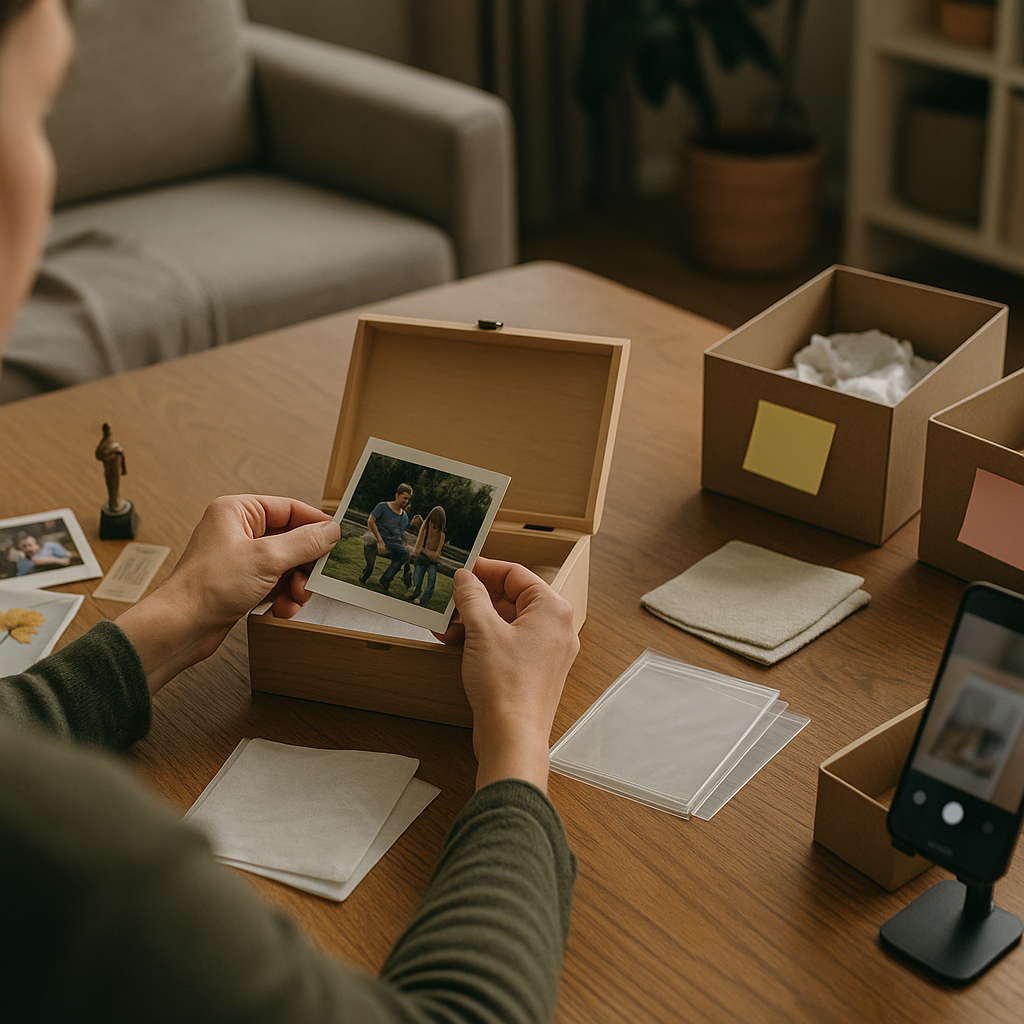
Most decluttering advice falls apart the moment you reach the box of your grandmother’s letters, your child’s first pair of shoes, or the ticket stubs from a concert you’ll never forget. The usual rules—”if you haven’t used it in a year, toss it”—feel almost offensive when applied to objects that hold memory rather than function. That’s why sentimental items get shoved back into closets year after year, untouched and unresolved.
The good news: you don’t have to choose between living in a museum of your own past and ruthlessly purging everything that matters. There’s a middle path, and it starts with treating sentimental clutter as its own category with its own method. This guide walks you through that method step by step.
Why sentimental items are uniquely hard to declutter
Ordinary clutter is a logistics problem. Sentimental clutter is an emotional one, and that changes everything about how you approach it.
When you hold an object connected to a person, a milestone, or a version of yourself you’ve outgrown, you’re not really evaluating the object. You’re evaluating the relationship, the memory, and sometimes your own guilt. Letting go can feel like a betrayal—of a loved one who passed, of your younger self, or of the effort someone put into a gift.
A few specific traps make this category sticky:
- The fear that letting go erases the memory. We unconsciously treat the object as the memory’s container, as if discarding it deletes the experience.
- Guilt over gifts. Keeping something out of obligation to the giver, even when it brings you no joy.
- Identity items. Objects tied to a former career, hobby, or life stage that you’re not ready to admit is over.
- Inherited overwhelm. Boxes you received after a death that you’ve never actually opened because doing so feels too painful.
Naming the specific emotion at play is the first real step. You can’t problem-solve grief, guilt, and nostalgia the same way you problem-solve a messy junk drawer.
Prepare before you touch a single item
The biggest mistake people make is diving into sentimental items on a whim—usually at the end of a long decluttering day when they’re already drained. Decision fatigue is real, and it makes you either keep everything or, in a burst of frustration, throw away things you’ll regret. Set yourself up properly first.
Time it intentionally
Tackle sentimental items first when you’re rested, not last. Pick a window where you won’t be interrupted and you’re emotionally steady—not the anniversary of a loss, not after an argument. Give yourself a realistic block: two to three hours, not an entire weekend that you’ll come to dread.
Gather the right supplies
- A “definitely keep” box for the items that are easy yeses.
- A “maybe” box—this is your pressure-release valve.
- A donation bag and a recycling/trash bag.
- A “rehome” pile for items that belong to or would mean more to someone else.
- Your phone or a camera for photographing items you want to remember but not store.
- Tissues and a glass of water. Sounds small. It isn’t.
Decide on your storage limit in advance
This is the single most powerful preparation step. Choose a physical container—one memory box, one shelf, one bin—and commit to it before you start sorting. When you’ve decided that everything you keep must fit in one archival bin, every decision becomes a comparison rather than an abstract agonizing. Instead of “Is this worth keeping?” you’re asking “Is this worth more to me than what’s already in the box?”
A step-by-step sorting method
Work through one defined category or container at a time. Don’t dump three decades of memories onto the bed at once—that’s how people get overwhelmed and quit. Here’s a sequence that keeps you moving.
- Pick one small zone. One box, one drawer, one shelf. Finishing a small zone gives you momentum and proof you can do this.
- Handle each item once and ask the real question. Not “Could this ever be useful?” but “Does this item still earn its place in my life and my limited storage?”
- Sort the easy items fast. Obvious keeps go in the keep box, obvious trash goes in the bag. Don’t deliberate over things that are clearly one or the other.
- Use the “maybe” box for anything that triggers hesitation. Don’t force a decision on the hard items in the moment. Defer them.
- Photograph and release. For bulky or low-priority items with sentimental value—a child’s art project, an old trophy, a worn-out concert tee—take a clear photo, maybe with a note about why it mattered, then let the physical object go.
- Consolidate the keepers. Once you’ve sorted a zone, see if your keeps actually fit your predetermined container. If they don’t, you’re not done—go back and choose your true favorites.
Resist the urge to “organize” as you go. Pre-sorting, relabeling, and rearranging are procrastination in disguise. Decide first; organize the survivors later.
What to do with the genuinely hard items
Some categories deserve their own tactics because the standard approach doesn’t quite fit.
Gifts you feel guilty discarding
Here’s the reframe that helps most people: the purpose of a gift was fulfilled the moment it was given and received. The giver wanted to express care, and that exchange already happened. The object is not a debt you owe forever. You’re allowed to thank it, mentally, for the kindness it represented—and then donate it so it can be useful to someone else.
Items from someone who has died
Inherited belongings are the hardest of all, and you should be gentle with yourself here. You don’t have to decide everything at once. A practical approach: keep a small, curated selection that genuinely evokes the person—their handwriting, a signature piece of jewelry, one favorite sweater—rather than keeping everything out of fear. Quantity dilutes meaning. Ten boxes in storage you never open honor no one; one beautiful object you actually display does.
If the grief is still raw, it’s completely valid to box things up and revisit in six or twelve months. Just label the box with a date so it doesn’t become permanent invisible clutter.
Kids’ artwork and schoolwork
You cannot keep all of it, and you don’t need to. Create one folder or portfolio box per child per year. At year’s end, narrow it down to a handful of pieces that capture their stage. Photograph the rest and consider a printed photo book—it turns a chaotic pile into something you’ll actually look at.
Your “maybe” box
After you’ve finished sorting, seal your maybe box, label it with today’s date, and store it out of sight. Set a calendar reminder for three to six months out. When the date arrives, if you haven’t needed or thought about anything inside, you can let most of it go without the emotional charge that was there originally. Distance does the deciding for you.
Honoring memories without keeping the stuff
The core mental shift in this entire process is separating the memory from the object. The memory lives in you, not in the thing. That said, our brains love tangible cues, so give your memories a better home than a dusty box.
- Create a digital archive. Photograph or scan letters, cards, children’s art, and small mementos. Organize them into clearly labeled folders or a shared family album.
- Make something usable. Turn a stack of band t-shirts into a quilt, frame a single meaningful concert poster, or fill a shadow box with a few small treasures so they’re displayed instead of hidden.
- Write the story down. Sometimes what you really want to preserve is the narrative. A few sentences about why an object mattered can let you release the object itself.
- Pass it on with intention. Give a meaningful item to a relative or friend who’d treasure it. The memory continues, just in someone else’s care.
- Display your true keepers. An item worth keeping is worth seeing. If it’s good enough to store forever, it’s good enough to put on a shelf.
A memory you can revisit in a photo album or see on your wall serves you far better than one entombed in a sealed container in the attic.
Common mistakes to avoid
Even with a good system, a few predictable errors derail people. Watch for these:
- Starting when you’re emotionally fragile. Grief and decluttering at the same moment rarely go well. Wait if you need to.
- Trying to do it all in one marathon. Sentimental sorting is mentally taxing. Short, focused sessions beat exhausting all-day pushes.
- Keeping things “for the kids” who haven’t asked. Ask them first. Many adult children genuinely don’t want the items we assume they’ll cherish.
- Letting the maybe box become permanent. Without a deadline, “maybe” just means “yes” in slow motion.
- Confusing volume with love. Keeping more does not mean caring more. Curation is its own form of respect.
The bottom line
Decluttering sentimental items isn’t about getting rid of your past—it’s about choosing which pieces of it you want to carry forward, on purpose. Set a storage limit before you start, work in small zones when you’re rested, lean on a dated “maybe” box for the hard calls, and remember that a photograph or a written story can preserve a memory just as well as the object itself.
Your next step is simple: pick one small container this week—a single drawer or box—and run it through the method above. Don’t aim to finish everything. Just prove to yourself that you can let go of one thing and keep the memory intact. From there, the rest gets easier.